
We had an exciting meeting last week with Fabian Pease, a Stanford University Professor who was one of the inventors of microchannel COOLing. Let me tell you about this meeting...
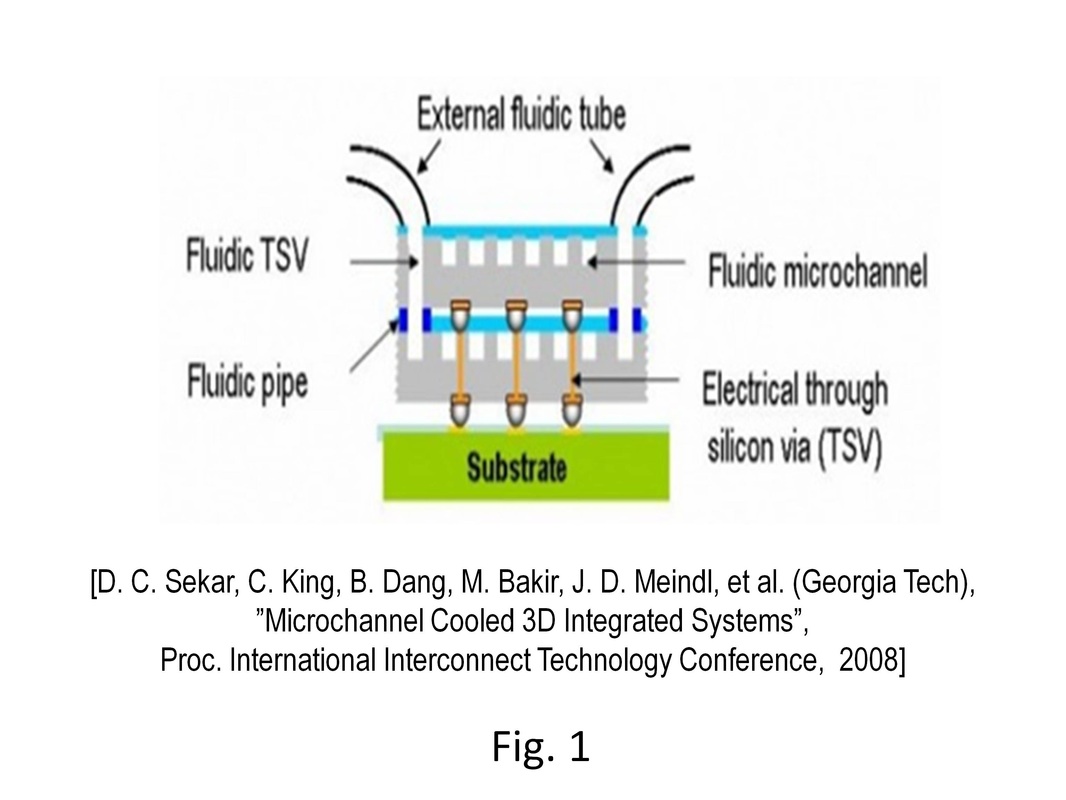
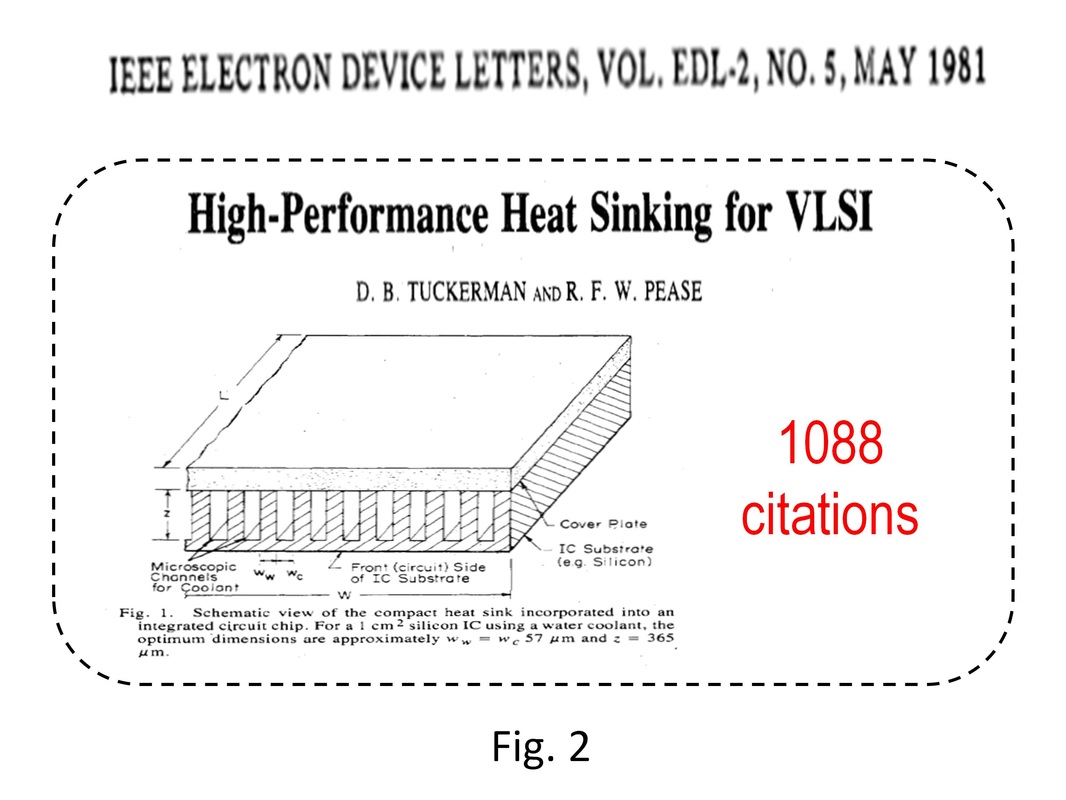
As many of you might know, my Ph.D. thesis at Georgia Tech involved cooling 3D chip stacks with liquids using a concept called microchannel cooling (Fig. 1). The microchannel cooling concept was invented in 1981 for silicon (2D) chips by David Tuckerman and Fabian Pease of Stanford University, who wrote a seminal paper on the subject back then. Check out Fig. 2 for details of this paper... it has more than a thousand citations today! Well, Brian Cronquist, our company’s VP of Technology, was acquainted with Fabian Pease and thought it would be a good idea to discuss our company’s ideas with him (Dr. Pease had done some of the first practically-viable work on monolithic 3D in the early 2000s). So meet Dr. Pease we did.
It was a really interesting meeting!
For starters, it is always nice to meet people whose work has greatly influenced you and your research. I had read the Tuckerman-Pease paper on microchannel cooling at least a dozen times during my PhD studies... Not just that, Dr. Pease is one of the world’s leading experts on lithography and 3D, and has tremendous subject knowledge. Add to it the fact that he shared several exciting stories from his career with us during the meeting. We were spellbound!
For starters, it is always nice to meet people whose work has greatly influenced you and your research. I had read the Tuckerman-Pease paper on microchannel cooling at least a dozen times during my PhD studies... Not just that, Dr. Pease is one of the world’s leading experts on lithography and 3D, and has tremendous subject knowledge. Add to it the fact that he shared several exciting stories from his career with us during the meeting. We were spellbound!
Let me first tell you a bit about Dr. Pease. In the early part of his career, he led the group at Bell Labs that developed the processes for e-beam lithographic mask manufacture, and demonstrated the first LSI circuit built with e-beam lithography. He joined Stanford University in the 1970s, and his work there includes the original demonstration of lithography with the scanning tunneling microscope, and the invention of the micro-channel heat sink. A story of many firsts indeed. Aside from the technical brilliance, Dr. Pease is a nice person and is very pleasant to interact with. I meet many Stanford students periodically since I am a consultant to a few research groups in the university, and they say Dr. Pease is a gentleman and is one of the professors they like the most. Yes, the title of this article is Professor Cool for more reasons than one.
Here are a couple of interesting things I learned at our meeting:
Trivia 1: What happened to David Tuckerman, the talented grad student who was the lead inventor of the microchannel cooling concept?
Answer: He’s now a venture capitalist! Check out his webpage here. Before his VC stint, he was CTO of Tessera, the well-known packaging company. Tuckerman co-founded a startup called nCHIP before his Tessera days.
Trivia 2: Finfets are now used in Intel microprocessors, and are expected to be the standard transistor type for all logic chips soon. Guess who was the DARPA program manager who funded the first Finfet project with UC Berkeley?
Answer: Fabian Pease. We found out Dr. Pease was recruited into DARPA in the 1990s by Lance Glasser, who was Director of DARPA at that time. Interestingly, Lance has served as an advisor to MonolithIC 3D Inc. for the past one and a half years :-) If you have time, check out Lance's website here. It has some neat content!
Well, we showed Dr. Pease our company’s ideas for doing monolithic 3D ICs for logic and memory. He listened to our presentation and said, “I’ve worked on litho for many decades, and it’s getting too costly nowadays. I think we need to look at approaches other than lithography to continue Moore’s law. Monolithic 3D is the future. You guys are onto something really big!” We were quite excited to hear this, and our CEO, Zvi Or-Bach, asked Dr. Pease if we could quote this to others publicly. And he said, sure, go ahead :-)
Interesting meeting, huh?
PS: Don't forget to visit us at Semicon West later this week at booth #5585. As Zvi mentioned in his Thursday blog-post, our technology has been selected as one of just three finalists for the "Best of West" Award :-) According to Semicon West, Best of West finalists are selected by a distinguished panel of semiconductor experts based on their financial impact on the industry, engineering or scientific achievement, and/or societal impact.
Trivia 1: What happened to David Tuckerman, the talented grad student who was the lead inventor of the microchannel cooling concept?
Answer: He’s now a venture capitalist! Check out his webpage here. Before his VC stint, he was CTO of Tessera, the well-known packaging company. Tuckerman co-founded a startup called nCHIP before his Tessera days.
Trivia 2: Finfets are now used in Intel microprocessors, and are expected to be the standard transistor type for all logic chips soon. Guess who was the DARPA program manager who funded the first Finfet project with UC Berkeley?
Answer: Fabian Pease. We found out Dr. Pease was recruited into DARPA in the 1990s by Lance Glasser, who was Director of DARPA at that time. Interestingly, Lance has served as an advisor to MonolithIC 3D Inc. for the past one and a half years :-) If you have time, check out Lance's website here. It has some neat content!
Well, we showed Dr. Pease our company’s ideas for doing monolithic 3D ICs for logic and memory. He listened to our presentation and said, “I’ve worked on litho for many decades, and it’s getting too costly nowadays. I think we need to look at approaches other than lithography to continue Moore’s law. Monolithic 3D is the future. You guys are onto something really big!” We were quite excited to hear this, and our CEO, Zvi Or-Bach, asked Dr. Pease if we could quote this to others publicly. And he said, sure, go ahead :-)
Interesting meeting, huh?
PS: Don't forget to visit us at Semicon West later this week at booth #5585. As Zvi mentioned in his Thursday blog-post, our technology has been selected as one of just three finalists for the "Best of West" Award :-) According to Semicon West, Best of West finalists are selected by a distinguished panel of semiconductor experts based on their financial impact on the industry, engineering or scientific achievement, and/or societal impact.


 RSS Feed